
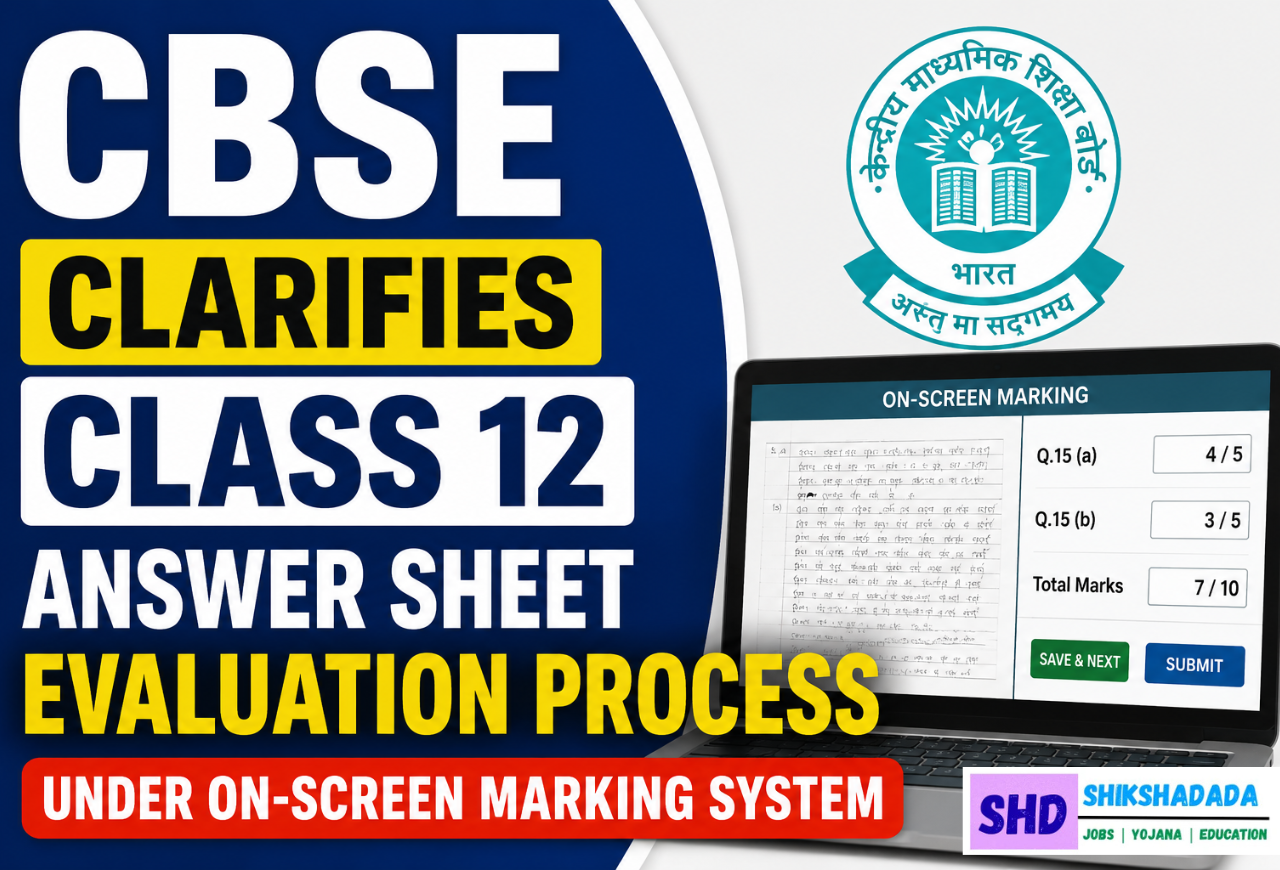
The Central Board of Secondary Education has explained in detail how Class 12 answer sheets were evaluated using the On-Screen Marking (OSM) system, addressing concerns raised by students and parents about transparency and accuracy in the result process. The board emphasized that the digital evaluation system ensures fairness, consistency, and error-free marking, while also maintaining strict monitoring mechanisms throughout the assessment cycle.
Key Highlights of CBSE On-Screen Marking System
| Particulars | Details |
|---|---|
| Board Name | Central Board of Secondary Education |
| Exam | CBSE Class 12 Board Exams 2026 |
| Evaluation Method | On-Screen Marking (Digital) |
| Objective | Transparent and error-free evaluation |
| Monitoring | Multi-level checking system |
| Result Accuracy | High due to digital verification |
What is On-Screen Marking System
The On-Screen Marking (OSM) system is a digital evaluation method where physical answer sheets are first scanned and then uploaded to a secure platform for evaluation by examiners. This system eliminates the need for physical handling of answer copies and allows evaluators to check responses on a computer screen, ensuring greater accuracy and efficiency compared to traditional methods.
How CBSE Evaluates Answer Sheets Digitally
Under the OSM system, answer sheets are scanned at designated centers and then distributed randomly to trained examiners through a secure digital network. Each examiner evaluates answers based on a standardized marking scheme provided by CBSE, ensuring uniformity across all responses. The system also includes features like auto-flagging of unchecked answers, mandatory question marking, and real-time monitoring, which help minimize human errors and discrepancies.
Measures Taken to Ensure Transparency
CBSE has implemented multiple layers of checks to maintain transparency in the evaluation process. The board uses quality control checks, head examiner reviews, and digital audit trails to verify the marking done by examiners. Additionally, random re-evaluation and moderation processes are conducted to ensure that marks awarded are consistent and justified, which strengthens trust in the final results.
Also read: SSC CGL 2026 Notification Soon at ssc.gov.in
Benefits of On-Screen Marking System
The digital evaluation system offers several advantages including faster result processing, reduced chances of manual errors, and secure handling of answer sheets. It also ensures that every answer is evaluated without omission, as the system does not allow submission unless all questions are marked. This has significantly improved the overall reliability of the CBSE result system.
Important Links
| Description | Link |
|---|---|
| Official Website | Visit Website |
| CBSE Results Portal | open here |
| CBSE Academic Website | Visit Here |
FAQs
What is the On-Screen Marking system used by CBSE?
It is a digital method of evaluating answer sheets where scanned copies are checked on a computer to ensure accuracy and transparency.
Does OSM reduce errors in evaluation?
Yes, the system includes automated checks and monitoring, which significantly reduce human errors.
Are answer sheets checked by multiple examiners?
In some cases, random checks and reviews by senior examiners are conducted to ensure fair marking.
Can students apply for re-evaluation under this system?
Yes, students can still apply for re-evaluation or verification of marks as per CBSE guidelines.